
Reviewed · HISTORICAL TOURS
Six Women: A Seattle History Tour
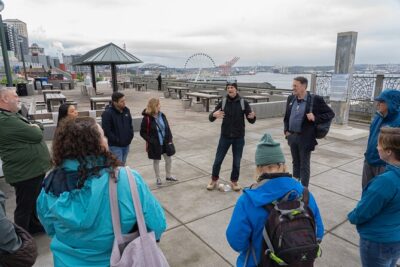
A good story can change the way you see a city. Six Women is that kind of walk, with small-group street history led by Carter and focused on WWII-era women’s lives and what downtown looks like when you know the names behind it. I like the historian-style pacing and the way the tour turns ordinary blocks into real, human moments. One possible drawback: it centers on adult themes linked to sex work, so it is not a fit for kids 16 and under.
You start at 700 1st Ave in Seattle’s Pioneer Square area, and you finish back where you began. Plan on about 90 minutes and roughly a 1 mile walk, with the route designed to be wheelchair accessible.
The ticket is $29 and the group stays small, which usually makes it easier to ask questions and hear the details clearly. If you want tidy, mainstream sights only, this tour’s subject matter may feel too edgy for your taste.
In This Review
- Key Things You Will Notice on This Six Women Tour
- Starting in Pioneer Square: a downtown story on a short leash
- WWII red-light district stories that are not just scandal
- Tattoo parlors, bars, and former brothel sites: why the stops matter
- The strike-and-pay theme: a clear human thread through the walk
- How the 1-mile, 90-minute pace actually works
- Is $29 a good value for Six Women?
- Who this tour fits best, and who should skip it
- Practical tips before you go to 700 1st Ave
- Should You Book Six Women? A quick decision guide
- FAQ
- How long is the Six Women walking tour?
- Where does the tour start?
- How far do you walk?
- Is it wheelchair accessible?
- What is included in the $29 price?
- What is the maximum group size?
- Can I get a refund if I cancel?
Key Things You Will Notice on This Six Women Tour
- Carter runs the show, with story-led commentary that connects people, power, and city change
- A short, walkable route (about 1 mile total), built for about 90 minutes
- WWII red-light district context shows how survival, work, and protest collided
- Stops tied to bars, tattoo parlors, and former brothel locations shape the route
- Wheelchair accessible with service animals allowed
Starting in Pioneer Square: a downtown story on a short leash
The tour begins at 700 1st Ave, Seattle, near Pioneer Square. That’s a smart way to start if you are staying central, since it is easy to find and you can pair it with other downtown plans before or after.
The walk is short, about 1 mile in total, with the Pioneer Square section itself covering roughly half a mile. This matters because you can get a focused experience without signing up for a half-day slog. You still get movement, but the schedule stays tight enough to keep the story and pace from dragging.
Carter’s approach is very much about how places earned their reputations. You are not just looking at buildings. You are learning why certain streets became meeting points, how entertainment districts functioned, and what people were fighting for when rules and pay fell apart during wartime.
WWII red-light district stories that are not just scandal
A key part of this tour is the specific WWII angle. You will hear about a red-light district tied to Oahu’s wartime reality, with Chinatown scenery in the story mix and a focus on the women who worked there. The big theme is labor and rights, including how they went on strike to demand better pay.
That changes the feel from salacious to serious. Yes, the subject matter involves sex work and adult nightlife. But the tour frames it as work under pressure, with real consequences when governments, military demand, and street-level economics all shift at once.
I also like that the tour doesn’t stop at gossip. Carter’s storytelling style brings in how women organized, what they risked, and how cities evolved around the needs of wartime life. One review specifically highlighted that Carter brought a lot of history on the women who helped shape Seattle into the more progressive city it is today, and that thread is what makes the tour stick in your mind.
A few other things to do around Seattle
- Beneath The Streets Underground History Tour
★ 4.5 · 8,006 reviews - Henry Art Tours-Come See the Fun Side of Seattle Art/Pubs/History
★ 5.0 · 27 reviews - Seattle Downtown Quest: Self-Guided History Adventure
★ 4.0 · 26 reviews
Tattoo parlors, bars, and former brothel sites: why the stops matter
You visit locations connected to tattoo parlors, bars, and former brothels. Even when a building’s original purpose is long gone, the tour uses the contrast to make a point: cities keep moving, but the past still leaves fingerprints.
This is one of the practical strengths of Six Women. The route gives you tangible markers for the story. Instead of hearing history in the abstract, you look at a real street corner, then Carter explains what that kind of place meant during that era.
There is also a pacing benefit. When you have a set of stop types, your attention stays locked in. You are walking, listening, and processing, rather than spending the whole time staring at a single plaque or monument.
One consideration: because the tour centers on nightlife and the history of prostitution, you may feel uncomfortable if you dislike adult-themed historical content. You might find this tour best when you are open to hearing harder stories presented with respect and context.
The strike-and-pay theme: a clear human thread through the walk
The heart of the tour’s storytelling is how the women went on strike. That detail turns the tour into something more meaningful than a rundown of old red-light places. You are watching history happen through action, not just through rumor.
Carter’s commentary is built around why strikes mattered in wartime. When demand surges and supply chains get distorted, the people doing the work are often the first to get squeezed. Better pay is not a small ask in that context. It is about fairness, dignity, and control over terms that were otherwise set for them.
You also get a sense of how quickly reputations spread. Chinatown corners become the stage for these stories because entertainment districts draw crowds, attention, and the sort of enforcement that can change overnight. You will come away understanding how street life, politics, and public opinion collided in a way that shaped how downtown neighborhoods developed later.
If you are the type who likes history with a cause-and-effect line, this is a strong match. The route is short, but the emotional arc is clear.
How the 1-mile, 90-minute pace actually works
This is a 1 hour 30 minutes walk, roughly 1 mile total. That time window is long enough for meaningful storytelling, but short enough that you can keep your energy.
The tour also covers about half a mile at Pioneer Square, so early on you are already moving and getting context quickly. This is good if you tend to lose patience with tours that start with ten minutes of logistical throat-clearing.
Wheelchair accessibility is part of the design. If you use a mobility device, that is an immediate plus, since downtown Seattle can be a mixed bag street by street. Service animals are allowed too, so you can plan with fewer hassles.
Still, keep in mind the pace is walking. If you have limited stamina, it helps to wear comfortable shoes and bring water, especially in warmer months. The tour is only 90 minutes, but you will be on your feet the whole time.
Is $29 a good value for Six Women?
For $29, you get a professional guide, a structured 90-minute walking route, and the small-group format that helps you actually hear the story. In plain terms, the price is low enough that this feels attainable for a single outing, not a major splurge.
What makes it good value is the combination of format and subject focus. You are paying for interpretation, not just transit between sites. Carter uses the stops as prompts to explain how wartime sex work operated, and how women pushed back through collective action.
Another value driver is that the group stays small, with a maximum number of travelers listed at 10. Small groups often mean less noise and fewer people speaking over the guide. It also tends to make Q and A more realistic.
If your travel style is snack-sized but high-impact, Six Women fits. If you want a long list of major landmarks, you might find you are still hungry for more after the tour ends back at the meeting point.
Rain in the forecast or not, these run out of Seattle too:




Who this tour fits best, and who should skip it
This is best for adults and older teens who enjoy darker, more human-centered history. If you like Chinatown settings, street-level stories, and the way a guide turns locations into meaning, you will likely have a good time.
It is also a good pick for people who want a different side of the past without committing to a huge day of sightseeing. The tour is about 1 mile, wheelchair accessible, and it runs in a single block of time that is easier to schedule than multi-hour museum tours.
If you are traveling with children 16 and under, this one is not recommended. Even beyond age, anyone who prefers upbeat topics only might feel uneasy with the adult themes of wartime prostitution and related nightlife history.
Practical tips before you go to 700 1st Ave
Start point is 700 1st Ave, Seattle, and the tour ends back at that same meeting point. If you are using public transit, you are close enough that it is workable, which helps if you do not want to fight parking downtown.
Bring comfortable walking shoes. You will cover about 1 mile, and the tour is guided nonstop for the 90 minutes, so you do not want footwear that slows you down.
If you use a wheelchair, it is explicitly wheelchair accessible, but you will still want to travel prepared for normal street conditions. Think traction, comfort, and the kind of weather Seattle gives you.
Finally, if adult subject matter is sensitive for you, decide ahead of time whether you want this kind of history. Six Women is not trying to sugarcoat. It is trying to explain.
Should You Book Six Women? A quick decision guide
Book Six Women if you want a small-group Seattle walking tour with a named guide, Carter, and you enjoy history that connects places to real people and real stakes. The standout part for me is the strike-and-pay angle, because it frames the story around labor rights and survival, not just scandal.
Skip it if you want mainstream downtown highlights only, or if adult themes and the history of prostitution would make you uncomfortable. Also skip if walking 90 minutes is hard for you, since the tour covers about 1 mile and is not described as a sit-and-read format.
If you fit the middle ground, this is a smart $29 outing. Short route, professional guide, and enough depth in the storytelling to make Pioneer Square and nearby downtown feel like more than just a starting point.
FAQ
How long is the Six Women walking tour?
It runs for about 1 hour 30 minutes.
Where does the tour start?
The meeting point is 700 1st Ave, Seattle, WA 98104, USA.
How far do you walk?
The tour covers about 1 mile total.
Is it wheelchair accessible?
Yes, the tour is wheelchair accessible.
What is included in the $29 price?
The professional guide is included. Transportation and hotel pickup and drop-off are not included.
What is the maximum group size?
The tour has a maximum of 10 travelers.
Can I get a refund if I cancel?
Yes. You can cancel up to 24 hours in advance for a full refund. If you cancel less than 24 hours before the start time, the amount paid is not refunded.
Written up lately around the Sound
- Seattle Customized Private Tour
- Enchanting Zipline , Camano Island and Deception Pass Tour
- Full Day Seattle’s W2 Tour – Wineries and Waterfalls
- From Seattle – Private Mt Baker and Cascades Tour in SUV★ 5.0 · 1 review
- Museum of Glass and Thea Foss Waterway Walking Tour★ 5.0 · 1 review
- Woodinville’s Downtown Wine Tasting Pass★ 5.0 · 1 review
- Seattle: Longmire in Mount Rainier Winter Day Tour★ 5.0 · 1 review
Historical Tours, compared.
Beneath The Streets Underground History Tour
Read our review →
Henry Art Tours-Come See the Fun Side of Seattle Art/Pubs/History
Read our review →
Seattle Downtown Quest: Self-Guided History Adventure
Read our review →

Bite-Sized Seattle History & Food by Go West Tours
Read our review →
Full-Day Small-Group Bainbridge Island Wine and History Tour
Read our review →
Browse the lists this tour appears in